
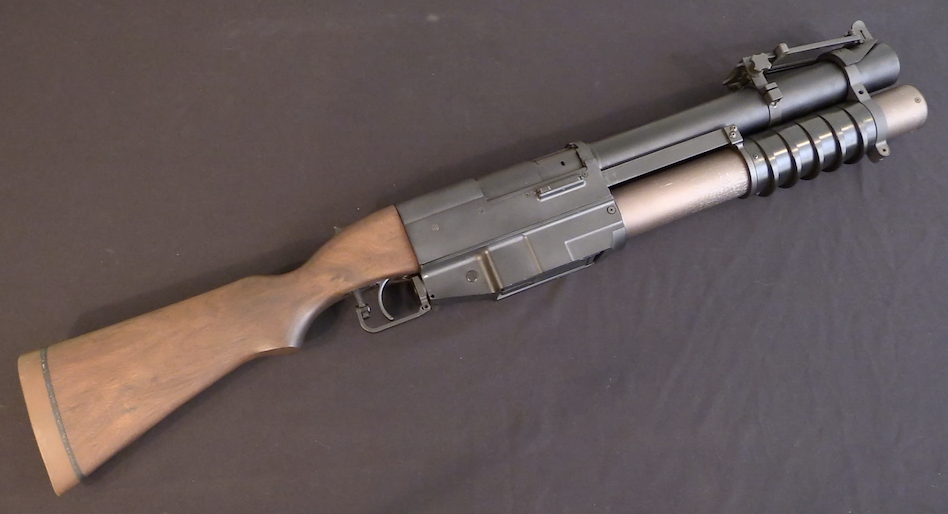
Introduction — What Is the China Lake Launcher?
The “China Lake Launcher” is a name that ignites curiosity among firearm enthusiasts, historians, and anyone fascinated by military technology. When most people hear the name, they imagine something exotic or linked to advanced weaponry from East Asia. In truth, the China Lake Launcher has a very specific origin in U.S. military history, rooted in innovation, necessity, and the relentless pursuit of effectiveness in combat. It is not a weapon imported from China, nor does it have any association with the Chinese military—it was developed by American forces.
The China Lake Launcher was designed as a pump‑action, large‑caliber grenade launcher. Its defining feature was manual cycling, similar to that of a shotgun, allowing a trained operator to fire rounds rapidly in a way that most single‑shot or grenade launchers of the era could not match. This capability gave it a reputation for reliability and combat performance.
Although relatively obscure outside military circles, the China Lake Launcher occupies a unique place in the lineage of infantry support weapons. Its development tells a fascinating story about how frontline soldiers innovate when standard equipment doesn’t meet real‑world needs. In this guide, we’ll explore its history, structure, operation, tactical role, influence on later weapons, variants, cultural impact, and much more.
Historical Background — How and Why It Came to Be
The China Lake Launcher originated during the Vietnam War, a conflict defined by jungle ambushes, rapid movement, and guerrilla tactics. U.S. forces needed weapons that could deliver explosive firepower quickly and reliably in close‑quarters engagements. Standard grenade launchers of the 60s and early 70s, such as single‑shot designs, lacked the speed and ease of use required in intense firefights.
A group of Navy SEALs and Special Forces realized this gap first‑hand. At the time, there was no mass‑produced, rapid‑fire grenade launcher available to troops. The traditional approach was to use rifles with underslung launchers, single‑shot stand‑alone launchers, or mortars—none of which provided both firepower and quick follow‑up shots in compact settings.
What began as a field adaptation and experiment at a maintenance facility near China Lake, California, eventually evolved into a purpose‑built weapon. Hence the nickname “China Lake Launcher.” This facility was part of the Naval Weapons Center and became a hub for custom weapon design and modification. Engineers and soldiers collaborated, combining practical combat experience with mechanical expertise to produce a launcher that could change the tempo of engagements.
Design Philosophy — The Reason Behind Its Complexity
Understanding the design philosophy behind the China Lake Launcher means appreciating the tactical realities of close combat in Vietnam. In dense vegetation, small squad patrols could suddenly encounter large enemy forces. Michael Shock, a fictional name representing many operators in historical accounts, would tell you that every second counted—there was no time for carefully lining up single‑shot rounds.
The goal was to make a launcher that could be fired quickly, reloaded quickly, and maintained easily. Automatics existed, but early automatic grenade launchers were heavy, bulky, and often unreliable in the humid Vietnam climate. A pump‑action mechanism offered speed without the complexity of gas‑driven cycling systems that were prone to fouling or failure.
The pump action also meant that the operator maintained a direct physical connection with the weapon’s action, offering a level of control and reliability that was valuable when every shot mattered. The philosophy was straightforward: if it doesn’t work in combat, redesign it.
Technical Specifications — What Makes It Mechanically Unique
The China Lake Launcher was based on a 12‑gauge shotgun platform but modified extensively. The caliber typically used was 40mm, which is consistent with standard grenade launcher ammunition. The launcher’s action was manually cycled using a sliding fore‑end, much like that of a pump shotgun. However, unlike most shotguns, it was designed for larger, explosive grenade rounds.
One of the standout components was the reinforced receiver and barrel assembly, built to handle the higher stresses of grenade propulsion compared to shotgun shot. The design had to balance durability with the need for a lightweight platform that could be carried by a single operator.
Internally, the launcher used a tubular magazine under the barrel, allowing multiple rounds to be loaded in sequence. This meant a soldier could fire repeatedly without stopping to reload after each shot. The simplicity of construction minimized potential failure points and made field maintenance easier for soldiers who often lacked full armorer support.
Mechanics in Action — How It Functions in Combat
Operating the China Lake Launcher is intuitive for anyone familiar with a pump shotgun, but its nuances were designed for tactical advantage. The operator loads rounds into the tubular magazine. Each pull of the pump mechanism extracts a spent casing and chambers a fresh grenade round. Unlike bolt‑action or singleshot launchers, this means that follow‑up shots are fast and fluid.
In combat, this translated to a higher rate of accurate firepower. Instead of firing once and waiting precious moments to reload, SEALs and special forces troops could deliver several explosive rounds in rapid succession. In jungle ambushes, this meant suppressing enemy fire and clearing paths with less exposure to return fire.
The simplicity of the mechanical design also meant fewer malfunctions due to dirt, mud, or moisture—common disruptors in Vietnam’s harsh environments. If a round failed to fire, an operator could simply pump the weapon again and chamber the next round, rather than troubleshoot a complex mechanism under stress.
Tactical Role — How the China Lake Launcher Was Used
The China Lake Launcher was not a frontline rifle replacement; instead, it functioned as a force multiplier. In SEAL teams, it was often assigned to a designated grenadier whose role was to provide indirect explosive fire while assault teams advanced.
During riverine operations, for example, boats moving through narrow canals could be ambushed from dense foliage on both sides. Traditional rifle fire might keep enemy heads down briefly, but explosive rounds capable of clearing vegetation and enemy positions changed the dynamics of these engagements.
Urban or village assaults also benefited. A single grenade could clear a bunker or fortified doorway better than multiple rifle rounds. The ability to pump and fire again meant that if hostiles regrouped behind walls or barriers, follow‑up rounds were immediately available.
Performance and Effectiveness — Real‑World Combat Feedback
Accounts from soldiers who used or faced the China Lake Launcher highlight its effectiveness. One SEAL operator reported that enemy forces unfamiliar with such rapid explosive firepower often assumed they were confronting heavier artillery than infantry‑borne launchers. This had psychological as well as tactical impact.
In terms of reliability, warfighters consistently praised the pump action’s resistance to jamming under battlefield conditions. With simple cleaning tools and basic field skills, the launcher could be kept operational for long missions. This reliability stood in contrast to some early automatic weapons that required frequent armorer maintenance.
Critics sometimes pointed out limitations: the weight and bulk relative to a rifle meant it was a specialized weapon carried by only a few per unit. However, for the operators equipped with it, the China Lake Launcher became a tool they often preferred when clearing enemy strongpoints or heavy cover.
Variants and Modifications — How It Evolved Over Time
Although the original China Lake design was limited in numbers, its influence spread. Gunsmiths and military engineers experimented with improved magazine capacity, changes in sighting systems, and refinements to the pump action mechanism. Some variants tried different calibers, while others focused on ergonomics.
One common modification was the addition of optical or reflex sights, improving accuracy in rapid engagements. Traditional iron sights were fine for general use, but enhanced optics allowed grenadiers to place explosive rounds more precisely, reducing wasted ammunition and increasing tactical impact.
There were also attempts to further lighten the launcher using alternative materials, especially for troops who needed mobility over sustained periods. While not all modifications reached widespread adoption, the experimentation highlighted how the China Lake concept continued to inspire designers.
Comparison to Other Launchers — How It Stacks Up
In the era of its introduction, most grenade launchers were either single‑shot stand‑alone designs or under‑barrel attachments to rifles. These systems had clear limitations. Single‑shot launchers required reloading after each fire, and under‑barrel designs could only fire one round before the operator had to switch back to the rifle or reload.
The China Lake Launcher bridged that gap. Unlike single‑shot designs, it offered multiple shots without reloading. It also allowed the operator to focus on explosive delivery rather than juggling between rifle and launcher duties. In essence, it combined the firepower of a grenade launcher with the rapid action of a pump shotgun.
Later automatic grenade launchers like the M203 and M79 under‑barrel systems became standard in many armies, but even these didn’t offer the same mechanical simplicity as the China Lake. While automatic systems provided full cycling, they introduced more points of failure and were not always as well‑suited to the dense, muddy environments where the China Lake excelled.
Notable Engagements and Historic Use Cases
Because the China Lake Launcher was used in relatively limited numbers and mainly within special operations units, it doesn’t dominate military history in the way some mass‑produced small arms do. Still, it played key roles in specific operations where its unique capabilities made a tactical difference.
One documented engagement involved a riverine patrol ambushed in dense foliage. The grenadier equipped with a China Lake Launcher was able to fire multiple 40mm rounds rapidly, clearing vegetation and enemy positions that would have taken significantly more time with a single‑shot launcher or rifle fire alone. This scenario demonstrates how a weapon that seems niche can become decisive in the right context.
Another documented incident occurred during a twilight assault on a fortified village. Rapid explosive fire suppressed hostile positions, forcing retreat and allowing assault teams to secure ground with fewer casualties.
Each of these examples underscores how proper use of the China Lake Launcher could turn dangerous situations in favor of U.S. forces and provide support that conventional weapons of the time struggled to match.
Training and Handling — What Operators Needed to Know
Mastering the China Lake Launcher involved rigorous training, but the learning curve was not as steep as more complex weapons. Operators first learned basic gun handling, safety, and maintenance—foundational skills common to all infantry weapons.
Next came specific drills on loading and cycling the pump mechanism under stress. Training emphasized speed, smooth operation, and consistent maintenance to prevent failure. Because the launcher fired explosive rounds, rigorous safety protocols were also essential to prevent accidents.
Operators also practiced tactical positioning. Unlike rifles, which can be fired from many stances, the China Lake required stability for accurate grenade delivery, especially at longer ranges. Training scenarios included firing from cover, while advancing, and coordinating with rifle teams to maximize impact without friendly fire.
Maintenance and Field Care — Keeping It Operational
One of the advantages of the China Lake Launcher was its relative simplicity in maintenance. The main components could be disassembled and cleaned with basic tools commonly available in the field. This was a significant advantage over complex automatic systems that required more specialized armorer attention.
Routine maintenance included cleaning the bore after exposure to dirt or humidity, lubricating the sliding pump action, and inspecting springs and locking components for wear. Operators were trained to perform these tasks quickly during lulls in combat or at base camps before missions.
Because the launcher used 40mm rounds, operators also learned to inspect ammunition for defects, condition of the fuzes, and proper storage to prevent moisture damage. Simple care practices significantly extended the service life and reliability of the weapon in demanding environments.
Impact on Later Weapons and Modern Legacy
Even though the China Lake Launcher was never mass produced, its influence is visible in later designs and military thinking about infantry support weapons. Modern pump‑action grenade launchers such as the Milkor MGL or similar multi‑shot designs owe part of their conceptual lineage to what the China Lake achieved.
Today, many armies and special operations forces favor compact, rapid‑fire grenade launchers that provide flexibility without the weight and complexity of heavier systems. Some modern weapons incorporate electronic sights, advanced materials, and ergonomic improvements, but the core idea—rapid‑fire explosive delivery without sacrificing reliability—parallels the China Lake’s philosophy.
Collectors and firearm historians also celebrate the launcher as a rare example of frontline innovation. Original units are sought after by museums and private collectors, preserving a piece of military history that could have easily remained obscure.
Cultural Perception — Myth vs Reality
Because of its name, many people mistakenly assume the China Lake Launcher came from Asia or was somehow connected to Chinese military technology. This misconception is so widespread that it often appears in online forums, movies, and casual conversations about weapons.
In reality, the name refers to China Lake, California—specifically the Naval Weapons Center located there. The site became synonymous with weapons research and specialized fabrication during the Vietnam era. The name stuck, even though the launcher itself was a bespoke creation developed for a specific operational need.
The cultural mystique around the China Lake Launcher also highlights how names, once popularized, can take on lives of their own. For many firearm fans, hearing the name conjures images of futuristic or experimental weapons, even though its actual design was rooted in practical field requirements of its time.
Modern Collectibility and Legal Considerations
Because the China Lake Launcher was never massproduced, original units are extremely rare. Collectors of military firearms prize them for their historical significance, mechanical uniqueness, and the story they represent. An authentic China Lake Launcher can fetch high prices—often well beyond typical collectible small arms—due to its scarcity and iconic status.
However, owning such a weapon comes with legal complexity. In many countries, including the United States, grenade launchers and explosive ordnance are strictly regulated. Ownership, transfer, and display often require special permits, compliance with international treaties, and verification that any ammunition remains non‑live or inert.
For collectors, this means navigating not only the market but also the legal infrastructure governing weapons that are inherently explosive in nature. Museums and institutions often work with government agencies to preserve and display these artifacts safely, while private owners must ensure full legal compliance before acquiring one.
China Lake Launcher in Popular Media
The China Lake Launcher occasionally appears in films, video games, and literature, often portrayed inaccurately. Because its name sounds formidable and its appearance uncommon, storytellers sometimes use it to add a sense of intrigue or technological edge to a character’s arsenal.
In some video games, developers amplify its capabilities far beyond reality, featuring impossible firing rates or futuristic enhancements. While this can be exciting for entertainment, it further blurs the line between historical truth and creative fiction. For serious enthusiasts, distinguishing real specifications from creative exaggeration is part of the fun of understanding historical weapons.
Even so, the China Lake Launcher’s presence in media contributes to its mystique. It has become, in a sense, a cultural artifact as much as a physical one—symbolizing ingenuity under duress and the improvisational spirit of soldiers in combat.
Key Lessons from the China Lake Launcher Story
Studying the China Lake Launcher offers broader insights beyond firearm technology. One lesson is the value of user‑driven innovation. When end users face limitations in their equipment, the people actively using the technology often generate ideas that engineers back home might never consider.
Another lesson is the balance between complexity and reliability. In designing solutions, more features don’t always mean better performance. Sometimes, simplicity—especially under harsh conditions—is the key to effectiveness.
Finally, the story reminds us that history often hides gems beyond mainstream attention. The China Lake Launcher may not be as famous as the M‑16 rifle or the M60 machine gun, but its role in specialized operations and its influence on later designs earn it a place of respect among military technologies.
FAQs
What is the China Lake Launcher?
A pump‑action, multi‑shot grenade launcher developed by U.S. forces during the Vietnam War.
Was the China Lake Launcher made in China?
No—it was developed in the United States, named after China Lake, California.
What caliber does it fire?
Typically 40mm grenade rounds.
Is it a fully automatic weapon?
No, it’s manually cycled using a pump action.
Why was it developed?
To provide rapid, reliable explosive firepower where single‑shot launchers were insufficient.
Did it see extensive combat use?
It was used in limited numbers by special operations units.
Is it legally owned by collectors today?
Ownership is rare and highly regulated.
Did it influence other weapons?
Yes, it helped inspire later rapid‑fire grenade launcher designs.
Also read:Ford Louisville Assembly: A Century of American Manufacturing Excellence