
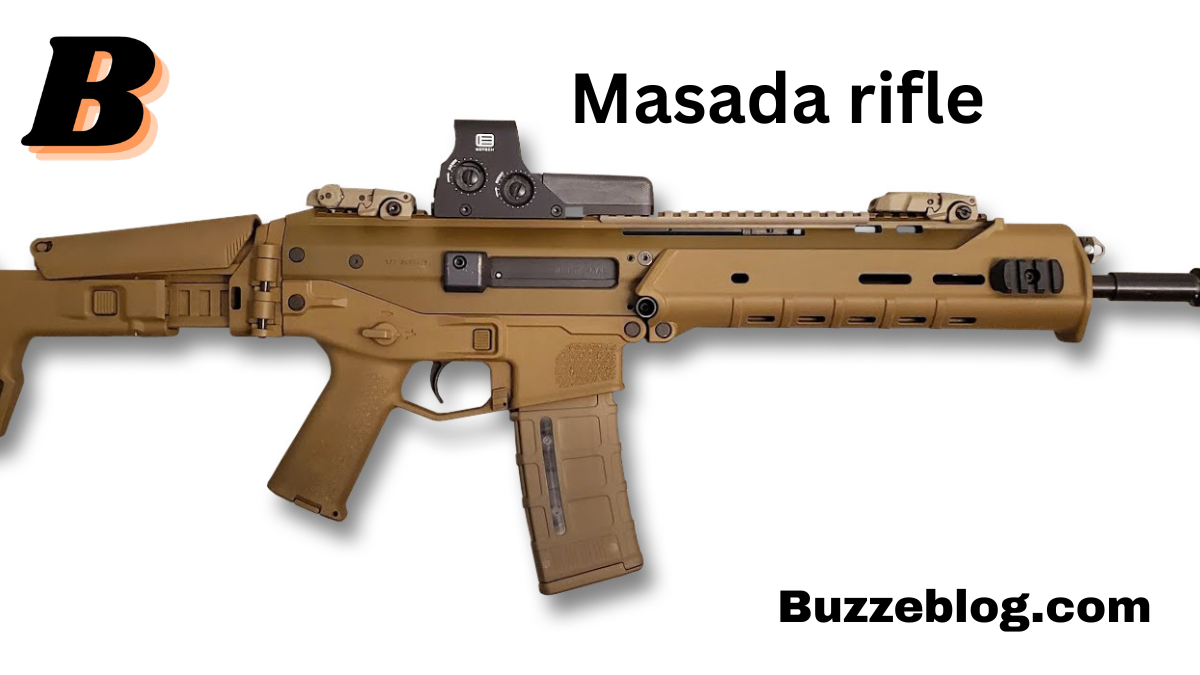
The Masada rifle is one of those firearms that immediately sparks curiosity among military enthusiasts, firearms collectors, and tactical professionals alike. Known for its modular engineering and forward-thinking design, it represents a major step in the evolution of modern combat rifles. When it was first introduced, many experts described it as a platform that combined the best features of multiple legendary rifles into a single adaptable system.
What makes the Masada particularly fascinating is that it was built around a philosophy of flexibility. Instead of forcing soldiers or users to adapt to a rigid weapon system, the rifle was engineered so that it could be modified quickly depending on mission requirements. Whether changing calibers, barrel lengths, or operational configurations, the Masada was designed to evolve alongside modern warfare.
In this comprehensive guide, we will explore every important aspect of the Masada rifle—from its origins and design philosophy to its technical capabilities, real-world applications, advantages, limitations, and future relevance. By the end, you will understand not only what the Masada is but also why it remains such an influential firearm in discussions about next-generation rifles.
The Origin Story of the Masada Rifle

The Masada rifle did not appear overnight. It was the result of years of innovation within the firearms industry, particularly during a time when military forces worldwide were seeking lighter, more modular weapons. Traditional rifles were dependable, but they often lacked adaptability. Designers realized that the battlefield was changing, and weapons had to keep up.
The rifle was originally unveiled in the late 2000s, immediately capturing attention at major defense exhibitions. Industry insiders recognized that this was not just another incremental upgrade—it was a platform built from the ground up to address the needs of modern soldiers. Engineers focused heavily on ergonomics, ease of maintenance, and rapid configuration changes.
Another important factor behind the Masada’s creation was user feedback. Designers studied how soldiers interacted with their rifles in real combat situations. They noticed common frustrations: complicated disassembly, limited customization, and difficulty switching operational setups. The Masada attempted to solve these issues through intuitive engineering and simplified mechanics, creating a rifle that felt both modern and practical.
Design Philosophy: Built Around Modularity
At the heart of the Masada rifle lies a powerful idea: one rifle should serve multiple roles. Rather than manufacturing separate firearms for different tasks, the Masada platform allows users to reconfigure the weapon with minimal effort. This philosophy dramatically improves logistical efficiency for military units.
The modular approach also reduces training complexity. When soldiers become familiar with one platform that can transform into multiple configurations, they spend less time learning entirely new weapon systems. This consistency improves confidence and operational readiness, especially in high-pressure environments.
From a technical standpoint, modularity also future-proofs the rifle. As ammunition technologies evolve or mission requirements shift, a modular rifle can be upgraded instead of replaced. This adaptability is one reason why the Masada is often referenced in conversations about sustainable military procurement strategies.
Engineering and Construction Quality
A rifle’s reliability begins with its construction, and the Masada was engineered with durability in mind. Designers used advanced materials to balance strength and weight, ensuring that the rifle could withstand harsh conditions without becoming overly heavy for the operator.
The receiver design is particularly noteworthy. By separating key structural components, engineers created a system that is both rugged and easy to service. This means fewer tools are required for maintenance, and damaged components can often be replaced quickly in the field.
Attention to detail is visible throughout the rifle. Controls are positioned for ambidextrous use, allowing both left- and right-handed shooters to operate the weapon comfortably. The charging handle, safety mechanisms, and magazine release are all strategically placed to promote efficiency without sacrificing safety.
Ergonomics and User Comfort
One of the most praised aspects of the Masada rifle is its ergonomic design. Firearms are tools that must function as natural extensions of the user’s body, and the Masada excels in this area.
The adjustable stock allows shooters to tailor the rifle’s length to their physique or tactical gear. This is especially important for soldiers wearing body armor, as a fixed stock can compromise shooting posture and accuracy. With an adjustable system, the rifle remains comfortable across a wide range of operational setups.
Grip design also plays a critical role. The Masada features a grip angle that promotes a relaxed wrist position, reducing fatigue during prolonged use. Combined with balanced weight distribution, this makes the rifle easier to handle in both static and dynamic shooting scenarios.
Caliber Flexibility and Conversion Capabilities
Perhaps one of the most innovative elements of the Masada platform is its ability to switch calibers. This feature gives users the flexibility to adapt the rifle for different missions without needing an entirely separate weapon.
Caliber conversion typically involves swapping out specific components such as the barrel and bolt assembly. The process is designed to be straightforward, minimizing downtime and allowing operators to reconfigure the rifle efficiently.
This flexibility also offers logistical advantages. Military units can standardize around a single platform while still supporting diverse ammunition requirements. For example, one configuration might prioritize long-range performance, while another focuses on close-quarters maneuverability.
Barrel Options and Performance Impact
The barrel is one of the most critical elements of any rifle, directly influencing accuracy, velocity, and overall performance. The Masada’s interchangeable barrel system allows users to select lengths tailored to their operational needs.
Shorter barrels are typically favored in urban environments where mobility is crucial. They make it easier to navigate tight spaces without sacrificing too much ballistic performance. On the other hand, longer barrels enhance muzzle velocity and improve effectiveness at extended distances.
Another advantage of the Masada’s barrel system is maintenance. Instead of replacing the entire rifle when wear occurs, users can simply install a new barrel. This approach extends the lifespan of the platform and reduces long-term costs.
Accuracy and Shooting Dynamics
Accuracy is often the ultimate measure of a rifle’s effectiveness, and the Masada was engineered with precision in mind. Its stable operating system helps reduce recoil impulse, allowing shooters to maintain better control during rapid fire.
The rifle’s sight alignment and rail systems support a wide range of optics, enabling users to configure the weapon for specific engagement distances. Whether using magnified scopes or reflex sights, the Masada adapts easily to modern aiming technologies.
Trigger performance also contributes to shooting dynamics. A predictable trigger pull improves shot consistency, which is especially important in tactical situations where precision can determine outcomes. The Masada’s trigger system is generally regarded as responsive without being overly sensitive.
Reliability in Harsh Conditions
A rifle must perform reliably regardless of environmental challenges. Dust, mud, extreme temperatures, and moisture can all compromise lesser firearms, but the Masada was designed to handle demanding conditions.
Its operating mechanism emphasizes simplicity, reducing the number of components that could potentially fail. This streamlined approach enhances reliability while making field maintenance easier for operators.
Testing environments often simulate worst-case scenarios, and rifles that emerge from these trials earn strong reputations. The Masada’s engineering reflects lessons learned from decades of firearm development, prioritizing function over unnecessary complexity.
Tactical Versatility
Versatility is where the Masada truly shines. The rifle can transition between roles such as patrol weapon, designated marksman platform, or close-quarters tool depending on its configuration.
Accessory rails allow users to attach lights, lasers, grips, and other tactical equipment. This customization ensures that the rifle can be tailored precisely to mission requirements rather than forcing compromises.
For professional users, versatility is more than a convenience—it is a strategic advantage. Carrying a weapon that adapts to multiple scenarios reduces the need for additional gear and simplifies operational planning.
Maintenance and Field Stripping
Ease of maintenance is often overlooked by casual observers, but professionals know that a rifle’s serviceability directly impacts readiness. The Masada was engineered with straightforward disassembly in mind.
Field stripping can typically be completed without specialized tools, allowing operators to clean and inspect critical components quickly. This simplicity is particularly valuable in remote environments where access to armorers may be limited.
Regular maintenance not only extends the life of the rifle but also ensures consistent performance. By making the process intuitive, the Masada encourages proper upkeep—an essential factor in long-term reliability.
Comparing the Masada to Traditional Rifles
When compared to older rifle platforms, the Masada stands out for its adaptability. Traditional designs often excel in reliability but lack the flexibility required for modern combat environments.
Another difference lies in ergonomics. Many legacy rifles were designed decades ago when tactical gear was less advanced. The Masada reflects contemporary realities, accommodating body armor, communication equipment, and modern shooting techniques.
However, tradition still carries value. Some operators prefer proven platforms with decades of service history. The Masada bridges this gap by incorporating familiar mechanics while introducing forward-looking features.
Civilian Interest and Sporting Applications
Although originally developed with professional users in mind, the Masada platform also attracted attention from civilian shooters. Enthusiasts often appreciate firearms that combine innovation with practical usability.
In sporting contexts, modular rifles offer flexibility for different shooting disciplines. Users can configure their setup for precision shooting one day and dynamic competitions the next.
Collectors are also drawn to rifles that represent technological milestones. The Masada’s reputation as a next-generation platform makes it particularly appealing to those interested in the evolution of firearm design.
Training Benefits of a Modular Platform
Training efficiency improves significantly when a rifle platform remains consistent across configurations. Instead of learning entirely new control layouts, users can rely on muscle memory.
This consistency enhances reaction time during high-pressure situations. When controls are intuitive and familiar, operators can focus on decision-making rather than mechanical operation.
Additionally, modular rifles simplify institutional training programs. Organizations can standardize instruction while still allowing units to tailor weapons for specialized roles.
Advantages That Set the Masada Apart
One of the most obvious advantages is adaptability. Few rifles manage to combine modular engineering with user-friendly operation as effectively as the Masada.
Weight distribution is another strong point. A balanced rifle reduces fatigue and improves handling, which becomes increasingly important during extended operations.
Finally, the emphasis on ergonomics demonstrates a deep understanding of user needs. Comfort may sound secondary, but in reality, it plays a major role in accuracy and endurance.
Limitations and Considerations
No rifle is perfect, and the Masada is no exception. Advanced engineering often comes with higher production costs, which can influence adoption decisions.
Some users may also prefer simpler platforms with fewer configurable parts. While modularity offers flexibility, it can introduce additional considerations in terms of inventory and component management.
Adoption timelines can also affect perception. Even well-designed rifles must prove themselves over years of service before achieving universal trust.
Technological Influence on Future Rifles
The Masada helped push the firearms industry toward greater modularity. Today, many modern rifles incorporate features that were once considered groundbreaking.
Designers increasingly focus on adaptability, recognizing that the future battlefield will demand flexible equipment. The Masada demonstrated that a single platform could evolve rather than become obsolete.
This influence extends beyond military circles. Competitive shooters, law enforcement agencies, and civilian enthusiasts now expect higher levels of customization in their firearms.
The Role of Innovation in Firearm Evolution
Innovation drives progress in every industry, and firearms are no exception. The Masada represents a moment when designers reimagined what a rifle could be.
Instead of relying solely on incremental improvements, engineers embraced a holistic redesign. They examined how rifles were used, maintained, transported, and modified—and built a platform accordingly.
Such forward-thinking approaches often shape industry standards. Even if future rifles surpass the Masada in certain areas, its contribution to design philosophy remains significant.
Practical Lessons from the Masada Platform
One key lesson is that user-centered design matters. Tools perform best when they align with the needs and behaviors of the people who use them.
Another takeaway is the importance of adaptability. Equipment that evolves alongside changing requirements offers better long-term value than rigid systems.
Finally, the Masada illustrates that innovation must balance ambition with reliability. Cutting-edge features are meaningful only when they function consistently under real-world conditions.
Cultural and Industry Impact
Beyond technical performance, some rifles achieve symbolic status within the firearms community. The Masada gained recognition as a representation of modern engineering ambition.
Industry discussions often reference it when exploring the transition from traditional platforms to modular ecosystems. It serves as a benchmark for what thoughtful design can accomplish.
For enthusiasts, the rifle represents a blend of practicality and vision—a reminder that even well-established technologies can be reinvented.
Looking Ahead: Is the Modular Rifle the Future?
Trends suggest that modular rifles will continue gaining traction. As missions grow more complex, adaptable tools become increasingly valuable.
Manufacturers are investing heavily in research and development, exploring materials, ergonomics, and smart integrations that could define the next generation of firearms.
While no single rifle can predict the future, the Masada offers a compelling glimpse into what that future might look like: flexible, user-focused, and technologically refined.
Final Thoughts
The Masada rifle stands as a powerful example of what happens when innovation meets practical design. Built around adaptability, comfort, and performance, it challenged traditional assumptions about what a combat rifle should be.
Its modular architecture reshaped expectations across the firearms industry, encouraging designers to prioritize flexibility without sacrificing reliability. Whether examined from a technical, tactical, or historical perspective, the Masada remains an influential platform.
Ultimately, the rifle’s legacy is not just about its features but about the mindset it introduced—one that embraces evolution rather than resisting it. For anyone interested in modern firearm development, the Masada offers valuable insights into how thoughtful engineering can redefine an entire category of equipment.
FAQs
What is the Masada rifle known for?
It is primarily known for its modular design that allows users to quickly adapt the rifle for different roles.
Is the Masada considered a modern rifle?
Yes, it is widely regarded as a modern platform due to its adaptability and ergonomic engineering.
Can the Masada be customized easily?
The rifle was designed for straightforward customization, making configuration changes relatively simple.
Why is modularity important in rifles?
Modularity allows one weapon platform to serve multiple purposes, improving efficiency and flexibility.
Is the Masada suitable for professional use?
It was developed with professional users in mind, emphasizing reliability and operational versatility.
Does the Masada require complex maintenance?
No, it was engineered for simplified field stripping and routine upkeep.
What makes the Masada different from traditional rifles?
Its emphasis on adaptability and user-centered design sets it apart from more rigid legacy platforms.
Has the Masada influenced newer rifle designs?
Yes, many modern rifles reflect the growing industry focus on modular engineering.
Is ergonomics important in a rifle?
Absolutely, good ergonomics improve handling, reduce fatigue, and support better accuracy.
Will modular rifles dominate the future?
While nothing is guaranteed, industry trends strongly suggest that adaptable platforms will continue to grow in popularity.
Also read: Cola Champagne: The Sweet Sparkling Soda with a Surprisingly Rich History