
Introduction to the Numidian Cavalry
When historians discuss the greatest mounted warriors of antiquity, one group consistently stands out for its speed, adaptability, and battlefield intelligence: the Numidian cavalry. Originating from the region of Numidia in North Africa—roughly corresponding to parts of modern Algeria and Tunisia—these riders reshaped the way ancient armies thought about mobility. Instead of relying on brute strength or heavy armor, they demonstrated that precision, speed, and tactical awareness could dominate the battlefield.
What makes the Numidian cavalry especially fascinating is how naturally their military traditions grew out of everyday life. Horses were not just military tools; they were essential companions in travel, trade, and survival. From a young age, boys learned to ride across uneven terrain without elaborate equipment, building instincts that could not easily be taught in formal training environments. By adulthood, many riders had already developed extraordinary balance and control.
Their reputation traveled quickly across the Mediterranean world. Commanders who witnessed their effectiveness realized these horsemen could scout ahead, disrupt enemy formations, and retreat before retaliation became possible. In many ways, they operated like elite rapid-response units—appearing suddenly, striking efficiently, and disappearing just as quickly. Understanding the Numidian cavalry is therefore not just about studying a military force; it is about recognizing a tactical evolution that influenced warfare for centuries.
Geographic and Cultural Roots of Numidia
To understand why the Numidians became such exceptional riders, you must first examine the land they inhabited. Numidia featured fertile plains alongside harsh semi-arid regions, requiring communities to adapt constantly to changing conditions. Many groups lived semi-nomadic lifestyles, moving livestock between grazing areas. Horses became indispensable in this environment, providing both transportation and protection.
This landscape encouraged resilience and independence. Early Numidian society was not unified under a single centralized authority; instead, it consisted of tribal networks that valued courage and self-reliance. Warriors earned prestige through demonstrated skill rather than inherited status alone. As a result, martial ability became deeply intertwined with social identity.
Culturally, the Numidians favored practicality over display. While some Mediterranean armies emphasized polished armor and ceremonial formations, Numidian fighters prioritized what worked in real conditions. Heavy gear might have looked impressive, but it slowed movement and drained energy. By embracing simplicity, they created a fighting style uniquely suited to their terrain and lifestyle.
Equipment and Riding Style: Minimalism as Mastery
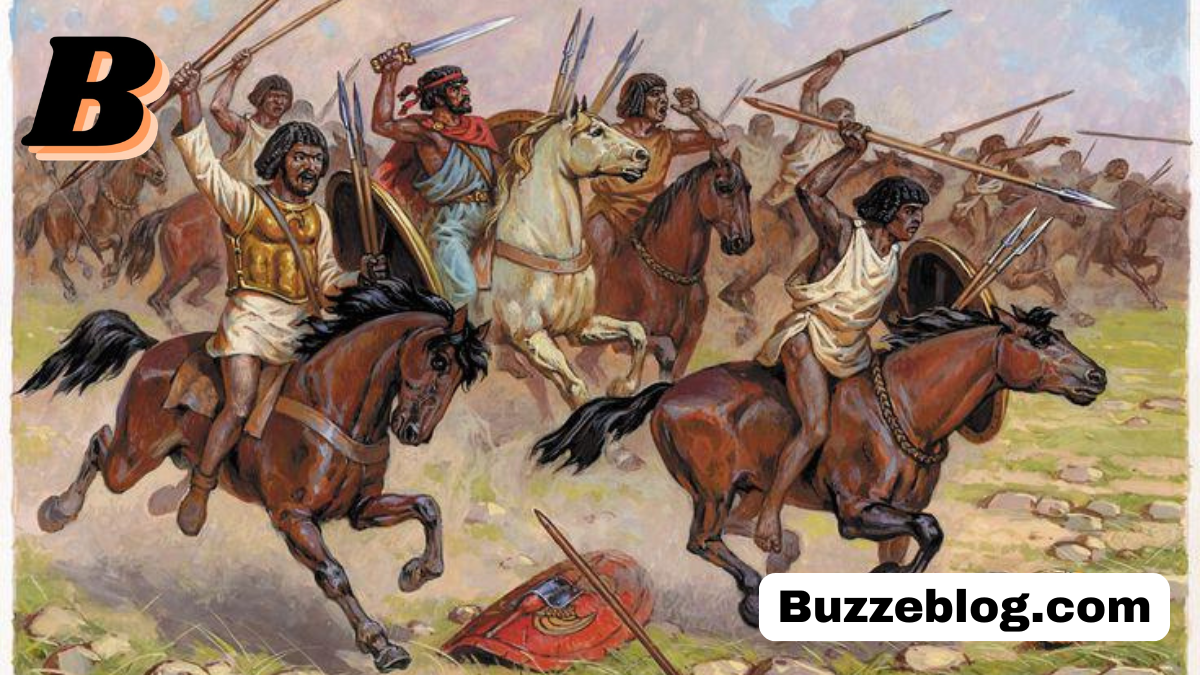
One of the most remarkable aspects of the Numidian cavalry was their minimalist approach to equipment. Many riders went without saddles and often controlled their horses using little more than a rope or neck strap. To outsiders, this might have appeared risky, but it actually allowed unmatched flexibility. Riders could lean, pivot, and shift weight instantly, making them elusive targets.
Their primary weapons were lightweight javelins designed for repeated throws rather than single decisive strikes. Instead of charging directly into enemy lines, Numidian horsemen circled opponents and launched volleys from a distance. After exhausting their supply, they could withdraw, resupply, and return to continue the assault. This rhythm kept enemies off balance.
Most carried small shields that provided essential protection without sacrificing speed. Some also had short blades for emergencies, though close combat was not their preferred method. Their horses—typically smaller than those used by heavier cavalry—were known for endurance and agility. Together, horse and rider functioned almost as a single organism, capable of movements that confused more rigid military formations.
Training and Lifestyle: Warriors From Childhood

Unlike soldiers who began training in adulthood, Numidian riders were shaped by their environment from an early age. Riding was not a specialized activity; it was part of daily survival. Children learned how to mount quickly, steer using subtle body cues, and maintain balance across long distances.
Hunting served as an informal training ground. Tracking fast animals required patience, coordination, and quick reactions—skills that translated directly into warfare. Over time, these experiences built a tactical mindset centered on observation and timing rather than raw aggression.
Endurance also defined their preparation. Campaigns could span vast distances under intense heat, and riders had to manage fatigue while remaining alert. This resilience made them invaluable allies and formidable opponents. Armies that underestimated their stamina often found themselves harassed repeatedly until morale began to erode.
Tactical Excellence on the Battlefield
The Numidian cavalry excelled because they understood a core principle of warfare: controlling the pace often determines the outcome. Rather than committing immediately to decisive clashes, they manipulated distance and timing. They attacked when conditions favored them and withdrew when risks increased.
Harassment was among their most effective tactics. An army already strained by long marches could suddenly face waves of riders launching javelins from afar. Even if casualties remained limited, the psychological impact was profound. Soldiers struggled to rest, supply lines faced constant threats, and commanders were forced into defensive postures.
Feigning retreat was another hallmark strategy. Riders sometimes pretended to flee, enticing enemies into pursuit. Once the opposing formation stretched and lost cohesion, the Numidians could pivot abruptly, counterattack, or guide pursuers into ambushes. This demonstrated a sophisticated grasp of battlefield psychology—evidence that strategic thinking was just as important as physical skill.
Role in the Punic Wars
The Numidian cavalry rose to lasting prominence during the Second Punic War, the monumental conflict between Rome and Carthage. Their alliance with the Carthaginian general Hannibal Barca allowed them to showcase their strengths on some of the ancient world’s largest stages.
At the Battle of Cannae, their speed and maneuverability proved decisive. While heavier cavalry units engaged Roman forces more directly, the Numidians specialized in disruption. They prevented organized counterattacks, harried exposed units, and contributed to the encirclement that turned the battle into one of history’s most studied military victories.
Interestingly, Numidian loyalties were not permanently tied to Carthage. Political shifts eventually brought many into cooperation with Rome. This transition highlights an important reality of ancient geopolitics: alliances often depended more on leadership and strategic advantage than on geography. Regardless of whom they served, their tactical value remained undeniable.
Famous Leaders and Political Influence
Among the most influential figures in Numidian history was King Masinissa. Initially aligned with Carthage, he later supported Rome after recognizing the long-term advantages of partnership with an ascending power. His decision altered the regional balance and helped secure his reputation as both a military commander and a pragmatic statesman.
Masinissa worked to unify previously fragmented tribes, promoting agricultural development and stronger political organization. Under his leadership, Numidia evolved into a more cohesive kingdom capable of projecting influence beyond its borders.
Leadership in Numidia often blended martial expertise with diplomatic awareness. Offering cavalry support could strengthen alliances and enhance bargaining power. In this sense, the Numidian cavalry functioned not only as a battlefield force but also as a strategic instrument in international relations.
Numidian Cavalry vs. Heavy Cavalry
Comparing Numidian riders with heavy cavalry reveals two contrasting philosophies. Heavy cavalry relied on shock—charging with force to break enemy lines. When successful, such assaults could end battles quickly, but they required precise coordination and favorable terrain.
The Numidians embraced flexibility instead. They avoided conditions where weight became a disadvantage. Uneven ground, steep inclines, or prolonged engagements often hindered heavily armored riders, while light cavalry adapted effortlessly.
This contrast illustrates a broader military lesson: effectiveness depends on context. Many commanders achieved their greatest successes by combining heavy units with agile Numidian riders, creating a balanced force capable of both impact and maneuver.
Integration Into the Roman Military System
Once allied with Rome, Numidian cavalry units became valued auxiliaries within Roman armies. Their scouting abilities allowed commanders to gather critical intelligence about terrain, enemy strength, and potential ambushes before major engagements.
The Romans were practical learners. Exposure to Numidian techniques encouraged them to reconsider aspects of their own cavalry doctrine. While they did not abandon heavier styles entirely, they increasingly recognized the importance of lighter contingents.
Importantly, the Romans allowed Numidian riders to retain much of their traditional approach rather than forcing rigid conformity. This respect preserved their effectiveness and contributed to a productive military partnership.
Psychological Warfare and Strategic Impact
Beyond physical combat, the Numidian cavalry excelled at shaping the emotional landscape of war. Unpredictable attacks generated anxiety among opposing troops. Soldiers who could not anticipate when the next strike might occur often became hesitant, which in turn increased the likelihood of mistakes.
Their presence also influenced broader strategy. Opponents had to divert resources to guard supply routes, strengthen reconnaissance, and maintain tighter formations. These adjustments slowed campaigns and consumed valuable energy.
In modern terms, the Numidians specialized in disruption. They did not always need to destroy an enemy outright; weakening cohesion could be enough to ensure eventual victory.
Decline and Transformation Over Time
No military tradition remains dominant indefinitely. As centuries passed, innovations such as improved saddles, stronger armor, and evolving weaponry reshaped mounted warfare across the Mediterranean.
Political transformations also played a role. Greater integration into the Roman sphere reduced local autonomy, and cultural blending led to hybrid military practices. Gradually, the distinctly Numidian style became less pronounced.
However, decline should not be mistaken for disappearance. The principles they championed—mobility, reconnaissance, and tactical flexibility—continued to influence later cavalry doctrines. Their legacy endured through adaptation rather than direct imitation.
Legacy in Military History
Military historians frequently regard the Numidian cavalry as pioneers of light cavalry strategy. Later mounted forces, from steppe riders to early modern skirmishers, echoed similar ideas: remain mobile, strike swiftly, and avoid unnecessary risk.
Their story challenges the assumption that technological superiority alone determines success. The Numidians thrived with relatively simple equipment because they maximized training, discipline, and situational awareness.
Today, their reputation persists in academic analysis and strategic discussions. Whenever scholars explore asymmetrical warfare—where agility counters strength—the conceptual roots often trace back to examples like the Numidian cavalry.
Lessons the Modern World Can Learn
Despite the centuries that separate us from their era, the Numidian cavalry offers insights that remain strikingly relevant. Adaptability, for instance, is invaluable in any competitive field. Organizations and individuals who pivot quickly often outperform those bound by rigid methods.
Preparation is another enduring lesson. Numidian expertise was not accidental; it emerged from years of consistent practice. Mastery rarely appears overnight—it is the product of discipline and repetition.
Perhaps most importantly, their history highlights the power of self-awareness. Instead of copying heavier armies, the Numidians embraced what made them different. That authenticity became their greatest advantage.
Conclusion
The Numidian cavalry stands as a powerful example of how geography, culture, and innovation can combine to produce extraordinary military capability. They were not the most heavily armed riders, yet their speed and intelligence reshaped expectations of mounted warfare.
From tribal beginnings to decisive roles in major Mediterranean conflicts, these horsemen demonstrated that creativity often matters more than sheer force. Commanders who understood their value gained a formidable edge, while those who ignored them learned costly lessons.
Ultimately, the legacy of the Numidian cavalry reminds us that effectiveness is not defined solely by strength. It is defined by adaptability, clarity of purpose, and the courage to approach challenges differently. Even today, their story continues to inspire strategic thinking across disciplines.
FAQs
What made the Numidian cavalry unique?
Their exceptional mobility, bareback riding techniques, and javelin-based tactics distinguished them from heavier cavalry forces.
Where did the Numidian cavalry originate?
They came from Numidia in North Africa, roughly corresponding to parts of modern Algeria and Tunisia.
Did the Numidians fight for Carthage or Rome?
They served both powers at different times, shifting alliances based on political leadership.
Who was the most famous Numidian leader?
Masinissa is widely considered the most influential king associated with Numidian military strength.
What weapons did Numidian cavalry typically use?
They primarily carried lightweight javelins, small shields, and occasionally short swords.
Why were they effective against heavier armies?
Their speed and hit-and-run tactics prevented opponents from engaging them in prolonged close combat.
Did Roman armies adopt Numidian methods?
Rome incorporated Numidian riders as auxiliaries and learned from their reconnaissance strategies.
Were Numidian horses different from other warhorses?
Yes, they were generally smaller but highly durable and capable of long-distance travel.
Which conflict best highlights their importance?
Their contributions during the Second Punic War are among the most frequently studied examples.
Why did their dominance eventually decline?
Advances in cavalry technology and shifting political structures gradually reduced their unique advantage.
Also read: Masada Rifle: A Complete Expert Guide to Design, History, Performance, and Modern Relevance